

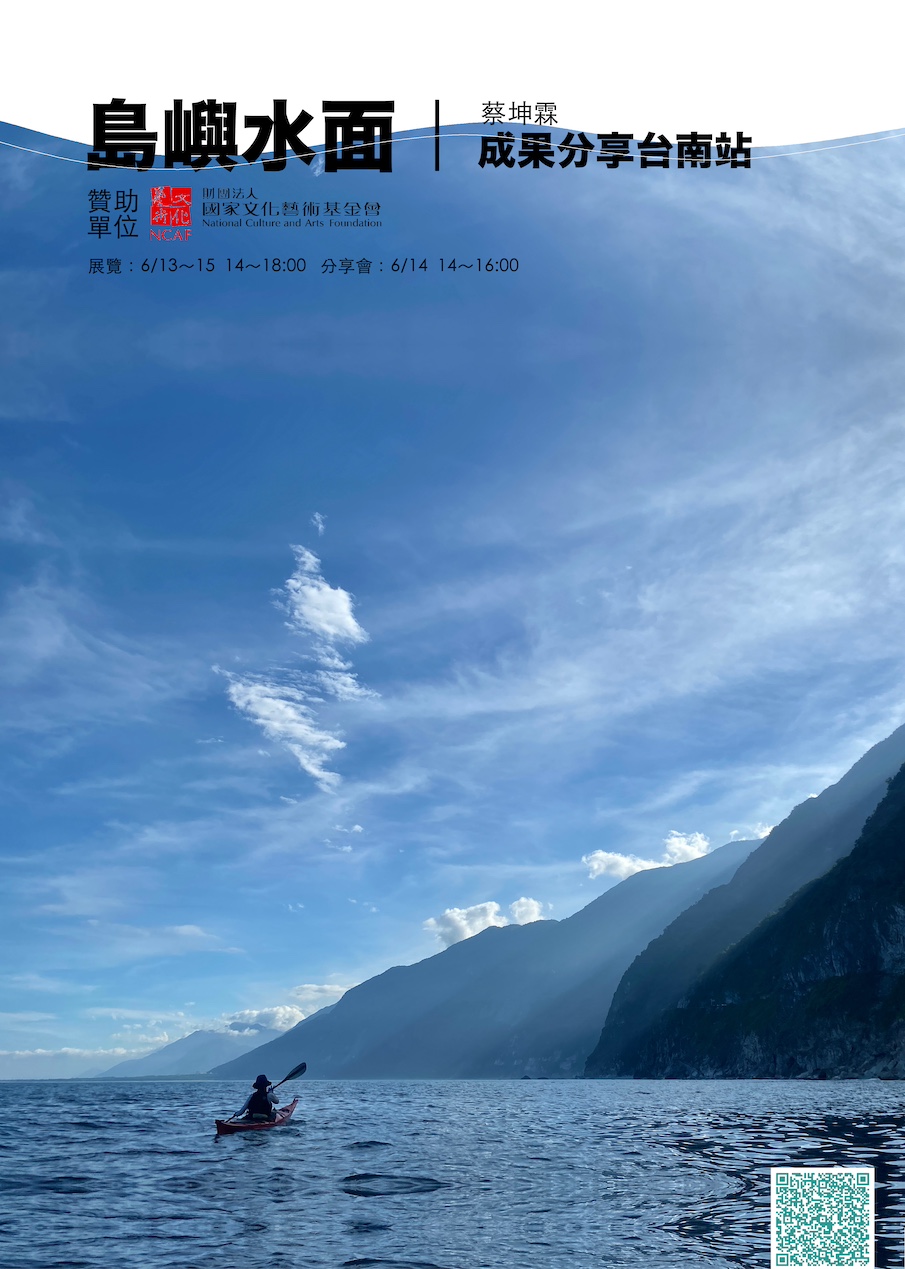
Introduction
In recent years, global environmental concerns have brought increasing attention to the relationship between water and sound, expanding the scope and depth of related research and artistic exploration. Yet, for those living on an island nation like Taiwan, the understanding of its water systems has often been reduced merely to the notion of “water resources.” The artist thus believes it is necessary to reengage with Taiwan’s hydrological landscapes through artistic creation, developing, together with art critics, a unique discourse on Taiwan’s island waters—one that not only reflects local perspectives but also resonates with global environmental issues, allowing Taiwan to speak within that context.
Building upon his long-standing engagement with water-related art, Tsai Kuen-Lin has been recording underwater sounds since 2015, followed by material collection and exhibitions such as Looking Back Project in Yokohama, Water and Sugar at Soulangh Cultural Park in Tainan, and Preserved Objects of Sea Flavor at Pier-2 Art Center in Kaohsiung, as well as the ongoing Taipei Lake Project. These experiences have evolved into a broader initiative—Island Formed by Water — An Artistic Project—which takes Taiwan’s major river systems and water domains as its central subjects of field research and creative exploration.
In 2019, the artist began acquiring underwater recording equipment to support his creative process. In 2021, he undertook training for operating powered boats, through which he came to recognize both the high risk and the high cost inherent in working within aquatic environments. Yet it is precisely through this process of direct immersion and observation that Tsai realized only by truly “entering” the waters can one construct an authentic, locally rooted discourse on Taiwan’s water systems.
簡介
由於近年全球環境議題使然,使得水域與聲音的相關研究與觸角越發多元,而身為海島國家的住民,卻對島國水系的認知只剩下「水利資源」的概念,因此藝術家認為有必要進行台灣水系的創作,藉由此計畫與藝術評論者共同生產獨特的台灣島嶼水域創作論述,亦可以此接續全球議題,台灣發聲。
基於藝術家蔡坤霖過去對於水域創作的經驗,包含自2015年開始的水下聲音採集,2018年至今的素材採樣與展覽,如橫濱的《回看計畫》、台南總爺的《糖混水》、高雄駁二的《海味醃漬》,以及現正進行中的《台北湖計畫》,藝術家將以上經驗擴展成以台灣重要河系水域為創作材料採集對象的《島嶼水面創作計畫》。
藝術家於2019年購置水下錄音器材進行創作,2021年開始接受動力小船駕訓,使其了解到水域創作的高風險與高成本,卻也在其操作工序中,瞭解到唯有真正的「進入」水域觀察,方得創造屬於台灣自己的水域論述。

島嶼水面創作計畫

Underwater Recording Equipment:
Microphone, Amplifier, Recorder, Headphones
水下錄音器材:
麥克風、擴大機、錄音機、耳機
Underwater Recordings from Various Locations:
各地水下錄音:
Soil Collection along the Waterbody:
水域旁取土:
Clay Processing and Test Samples:
製作黏土、試片:
Critical Essay
A Water County Almanac
by Enkaryon Ang
From the Starting Point of Koganecho
The riverbank was never a distinct line to begin with; rather, it was a site of intermingling—a space where the states of “presence” and “absence” coexist. The water’s surface marks the boundary between the gaseous and the liquid, while in other dimensions, water and land merge at the thresholds that separate them. Soil and vegetation slowly infiltrate the aquatic domain, and with the fluctuations of weather and climate, the river reveals its intrinsic uncertainty, instability, and fluidity. Metaphorically speaking, water has often been imagined as a figure of displacement—a contemporary image of refugees. Whether it is the smuggling boats on the Mediterranean or the unpredictable landings across Southeast and East Asia, rivers and seas as borders embody a dual disposition of inclusion and rejection—an ambivalent lover to human civilization.
Water carries an uncontrollable power, one that resists the temporal order prescribed by the state apparatus. In Taiwan, this reality is well understood through the recurring threat of typhoons. On another level, the very transparency of water and its contradictory relationship with land evoke a counter-image to the operation of the nation-state. In the Greater Tokyo area, the Ooka River intersects with the Keikyu Line in the district of Koganecho, Yokohama—a region once sustained by postwar black-market economies, intertwined with red-light and commercial zones. The riverbank, as a place of multiplicity and negotiation, naturally becomes an extended metaphor for the entanglement of social, political, and moral complexities.
Over the past decade, Koganecho has undergone a process of urban redefinition through the cultivation of art communities, repositioning itself as a creative district where “art and neighborhood coexist.” While urban regeneration has largely focused on revitalizing terrestrial space, artist Tsai Kuen-Lin’s 2018 sound field project in Koganecho articulates another hydrological imagination of the area—one that listens, rather than looks, to the flows of its water systems.
In the 2018 project The Retrospective Project — Koganecho, Tsai collaborated with artist Yamada Teppei and scientist Lin Tzu-Hao to measure the underwater acoustics of the Ooka River. The recorded sounds from beneath the surface were used in participatory workshops that guided local residents to understand the relationship between the river’s segments, the surrounding historical spaces, and the diverse frequencies containing traces of both physical and biological phenomena. To a certain extent, this project marked a crucial turning point in Tsai’s artistic trajectory. His long-standing practice of recording environmental sounds expanded from terrestrial environments into aquatic ecologies.
In addition to these participatory activities, Tsai presented Traces of the Hanging Clock at the 2018 exhibition Flying Supermarket — Koganecho Bazaar. Using PVC pipes—one of his signature materials—he constructed a sound installation that allowed visitors to “listen” to the acoustic flow of the Ooka River. The title refers to the area’s historical geography: the ancient inner bay, once shaped like a hanging clock. The resonance of the river thus entered the domestic interior, turning architectural space into a living body with the pulse of water. Through this work, hidden environmental issues were given form and audibility; the building, infused with the heartbeat of the river, began to breathe with the landscape itself.
Aquatic Bodies and Contemporary Art
To discuss contemporary art in relation to bodies of water inevitably involves the broader context in which “environmental issues” have become an integral part of our daily life. The effects of environmental degradation and pollution are no longer problems confined to distant places but are interconnected phenomena that implicate the entire planet. Among these, the contamination of water and surrounding soil by industrial effluents and waste stands as one of the most immediate and perceptible manifestations, accompanied by the escalating crises of global warming and rising sea levels.
Tsai Kuen-Lin’s residency project Preserved Taste of the Sea (2018), realized at the Pier-2 Art Center in Kaohsiung, was informed by the collision of port culture and marine ecology. Within Tsai’s artistic genealogy, this project brought forth the social and ecological dimensions of water in more intricate ways. The installation comprised numerous components—pipes, motors, and coastal rocks—arranged to form a sonic environment in which recordings of Kaohsiung Harbor’s underwater soundscapes were embedded inside PVC tubes. The collected sounds, ranging roughly between 0 and 4000 Hz, contained traces of microbial life inhabiting the harbor’s aquatic ecosystem.
Through the interaction of industrial debris, mechanical apparatus, and sonic residue, Preserved Taste of the Sea drew direct connections between the emotional, economic, and ecological dimensions of the port city. Audiences were invited to engage with these audible fragments of industrial civilization, thereby encountering the entangled narratives of the Capitalocene and Anthropocene.
The urgency of global environmental transformation and the precarity of human survival render environmental aesthetics increasingly crucial in the era of the Anthropocene. Yet environmental aesthetics must first confront the epistemological problem of science itself—namely, how artists can construct alternative modes of understanding nature distinct from scientific rationality, through cultural systems such as myth, folklore, or poetic reimaginations of the natural world.
In Taiwan, the aesthetic practices emerging from the environmental movements and identity politics of the 1980s—represented by figures such as Wu Mali—laid the groundwork for artistic engagement with ecology and society. Today, under the stimulus of new global discourses and scientific paradigms, the field of marine science has increasingly turned toward acoustic methods to understand the life forms dwelling in aquatic environments. The faint sounds detected by hydrophones—echoes, pulses, or vibrations—convey information not only about ecosystems but also about modes of existence and interspecies communication. For scientists, these are data; for artists, they are manifestations of sensory realities beyond the reach of human perception.
Through Preserved Taste of the Sea, Tsai expanded the perceptual scale of Kaohsiung Harbor from its visible industrial landscape to its submerged acoustic dimension. In doing so, he developed a distinctive artistic method grounded in environmental perception and an attunement to the nonhuman. His practice shifted from recording the audible surface of environments toward probing the latent sonic depths of ecological systems—transforming listening itself into an act of aesthetic inquiry.
Toward a Sonic Dimension of the World
Beginning with Preserved Taste of the Sea, Tsai Kuen-Lin’s practice entered a broader auditory field. During his subsequent residency at Soulangh Cultural Park, his underwater sound recordings extended to the Wushantou Reservoir, generating what could be considered the first sound artwork ever produced from this century-old waterbody. Coincidentally, the project took place amid a historic drought, transforming the act of listening into a meditation on exposure—how the infrastructures of the Japanese colonial period, once submerged, were revealed through the absence of water. The resulting work evoked not only the disaster landscape of desiccation but also a paradoxical experience: although the reservoir had diminished, Tsai was able to capture a different kind of aquatic sensation—a “sonic dryness,” so to speak—that approached the most complex dimension of contemporary environmental aesthetics.
Unlike scientific inquiry, which requires instrumental purpose and analytic precision, the artist’s approach to sound does not seek to reduce phenomena into data. Instead, it must translate the ineffable and the inaudible into experiential form. For the audience, such an aesthetic encounter demands mediation and cultural literacy; to perceive nature through art is to experience it through the frameworks of collective memory, local tradition, and historical consciousness.
In Water and Sugar (2021), Tsai integrated his collected underwater recordings into a sound installation presented at Soulangh Cultural Park. The work reconnected the sonic materials of water with the history of sugar production—the industrial and colonial infrastructures that had once relied upon these very water systems. Visitors, seated beneath an enveloping field of complex resonances, experienced a vertical acoustic flow, as if water were cascading from above. The sonic textures foregrounded the latent historical layers of the site: the colonial sugar industry, the reservoir constructed under successive regimes, and the entanglement of modern development with hydrological control.
The concept of “foregrounding,” as employed in literary and aesthetic theory, refers to the process by which certain perceptual elements are brought into heightened awareness while others recede. In Water and Sugar, the aquatic sounds do not merely represent “nature”; they articulate what cognitive or positivist frameworks fail to acknowledge—the instability of the earth, the precarity of material existence, and the limits of governmental control in the face of climatic uncertainty. By shifting the audience’s bodily perception, Tsai’s work discloses the contradictions inherent to both hydrological systems and human governance, compelling an awareness of the dynamic, uncontrollable, and profoundly ecological nature of sound.
At present, Tsai’s work confronts what might be called the “worlding of sound.” This “worlding” does not refer to globalization per se, but to the multiplicity of worlds inhabited by diverse life forms. The aquatic sounds he captures are not solely human in origin; they may belong to microorganisms, plants, animals, or even nonliving matter. Yet within human culture, such sounds are inevitably filtered and mediated. This challenge has become a critical juncture in Tsai’s practice: how to invent new artistic methodologies that grant these sonic materials renewed significance and ontological dimension.
From a scientific standpoint, an increasing number of researchers suggest that such sounds hold meaning for nonhuman life forms—for example, bacteria responding to antibiotics through vibrational cues, or the use of sonic observation to trace microbial life cycles. As low-frequency soundscapes are transformed by offshore wind farms and other infrastructures, new acoustic ecologies are emerging, mirroring the issues Tsai encountered at Wushantou Reservoir, where hydropower and water regulation converge into a nexus of aesthetic and ecological tensions.
The American environmental philosopher Aldo Leopold once wrote in A Sand County Almanac, “To the mouse, snow means freedom from want and fear.” The same phenomenon bears different meanings for different beings: to the mouse, snow is protection; to the hawk, it signals opportunity. In this non-unified world of sound, Tsai Kuen-Lin stands as one of the contemporary artists most attuned to redefining humanity’s relationship with the aquatic realm—a pioneer of hydrophonic aesthetics who continually expands the boundaries of how sound, matter, and environment may resonate together.
The Necessity of Creating One’s Own Sound
As one of the founding figures of sensory ethnography, Stefan Helmreich observes in Alien Ocean that each species develops its own epistemological relationship to the sea: “The primary categories of concern were introduced by ancient Polynesians or evolved within the historical experience of the Hawaiian people. These plants and animals constitute a natural heritage that should not be freely appropriated without consent or recognition of long-standing relations.” Such knowledge, born from environmental intimacy and geographical isolation, shapes how senses become forms of knowing.
In recent years, Tsai has entered this domain with decisive steps. Unlike scientists, whose work parses sound into measurable phenomena, Tsai situates sonic experience within the context of colonial history, environmental development, and climate culture. His project Water and Sugar has already illuminated how sound mediates both media and catastrophe, revealing the double bind of communication and destruction.
If Leopold’s A Sand County Almanac inscribed a philosophy of ecology through the seasonal life of the land, then Tsai Kuen-Lin is, in his own right, composing a Water County Almanac—an evolving chronicle of Taiwan’s waterscapes and the ways of living that flow within them.
評論文章
水縣日曆
文:印卡
從黃金町的起點談起
河岸一開始都不是條鮮明的線,而是交融的處所,是並存著「在與不在」的場域。水平面成為了空氣相與液相的邊界,在其他向度水體與陸地其相隔的邊界上交融。泥土與植被緩緩潛進水域,伴隨著氣候與天氣變化,河流展示了它不確定、不穩定、流動的特質。從隱喻上來說,對水的想像也常常是當代難民的形象,無論是地中海上偷渡的船隻或是東南亞、東亞無可預期的偷渡搶灘。河與海作為邊界在人文像象中,是涵納包容與拒絕的雙面情人。水體帶有著不可預測的力量,不符合國家機器計算好的時間性,台灣相當理解颱風來襲的風險。另外一方面,水體與陸地在語言中的矛盾性質,其透明性有時又是一種對國家運作的對比。大東京地區上大岡川與著京急線在日本橫濱黃金町相切的這個區域,過去從戰後黑市交易營生而出的生活型態跟混雜的商業區跟風化區,河岸的多重包容與複雜問題自然也是這隱喻的範圍。這十年間,黃金町隨著藝術社群的營造,重新定位此區域為「藝術與小區共生」的創意城市單元。隨著人們重新試圖活化陸地區域外,藝術家蔡坤霖在2018年在此區開展的聲音田野計畫可說是首先點明了黃金町的另一種水文想像。
2018年「回看計畫—黃金町」中,蔡坤霖與山田哲平、科學家林子皓合作,以水下聲學的方式量測了大岡川的水體聲響。這些水底聲音在當年曾以社會參與的方式帶領了群眾理解大岡川的河段與周邊的歷史空間的關係,還有各種不同頻率波段所可能包含的物理、生物等聲響。某種程度上來說,這是藝術家蔡坤霖,這幾年在音響裝置、公共藝術與環境版畫外,相當重要的創作轉向。原本過去聲音採集的環境聲響往陸上邁向了水體空間,也探索進了水的生態圈。這個參與活動之外,在同一年《Flying Supermarket—2018黃金町藝術市集》的展覽中,《掛鐘的刻痕》以蔡坤霖擅長的PVC管材,在黃金町的展場中直接架起了可以聆聽大岡川的空間聲音裝置(昔日內海形如掛鐘),水體之聲成為屋舍內在的循環。建築物有了水體聲響的脈搏,進而讓隱藏的環境議題有了形體。


水體與當代藝術
當代若要討論水體相關的藝術主題,我們就不能談「環境問題」成為我們日常生活一部分的必然──全球社會,自然破壞和環境污染的影響不是生活在彼端的人的局部問題,而是有機地聯繫在一起,讓整個地球帶來問題,工業廢水、工業廢棄物對水及其周邊土壤的污染常常是首要被意識到的現象,其中還包含了全球暖化、海平面上升的問題。蔡坤霖在駁二駐村《海味醃漬》得力於港埠文化的碰擊,讓水體更複雜的社會層面浮現在他的藝術系譜裡頭。《海味醃漬》的展覽中,大量的裝置以水管、馬達、海岸礁石組合而成,並在水管內部藏著蔡坤霖在高雄港採集的水體聲響。這些由藝術家出海收集高雄港周圍的聲響聲音落在0~4000(4K)赫茲之間,是生存在這一片水域微生物存在的痕跡。觀眾將能夠在《海味醃漬》的各種港都工業的撿拾物組成的物件,從相紙、對港埠的情感,直接連接到生態的聲響,資本世、人類世的議題。
全球環境變化與人類生存危機的緊急,環境美學尤其在人類世的時代顯得明顯。環境美學在這個議題下首先就得面對科學認識論不同的問題──換句話說,也就是這種對於同樣現象,藝術家如何不同於科學家透過文化系統,如民間傳說、自然神話,或是重新反思「自然」的藝術觀看來建立一套新的審美學興趣。在這方面80年代台灣環境運動與認同政治產生的美學實踐過去可說可以吳瑪俐為代表,但在新興議題與思潮的刺激下,在海洋科學中,已經有越來越多聲學研究來理解水體裡的生物形式。當各種不同微弱的聲響透過儀器被知悉其在水域裡的存在,這些聲響、迴波混雜著水域的環境、生物的構通類型以及存在實體──對科學家來說是生態系的資訊,對藝術家來說則是自然中人類不熟悉的感官形式。《海味醃漬》讓高雄港的形象蔓延到水域下的尺度,也藝術家的個人史內發展出獨特與環境感知的手法以及轉向。

邁向聲響的世界維度
從《海味醃漬》的轉向開始,藝術家蔡坤霖的作品有了更寬宏的聽覺領域。在緊接下來今年藝術家在總爺糖廠的駐村,水下聲音的採集前往了烏山頭水庫,成為了這一百年這個水庫的第一個水域聲響作品。再加上遇見百年大旱,在活動說明中,我們不僅知道日殖時期的基礎建設,如何因為雨量減少、水庫失能情況下被暴露了出來,構成了災難地景的議題;另外一方面,雖然在視覺上、日常感覺的矛盾,水庫的縮小似乎讓蔡坤霖收集到聲音並非水庫常態,但什麼是「旱季的水體感覺」或是旱季的聲響空間,正接近了當代環境美學最複雜的層次。
對環境美學欣賞與科學認識論不同,藝術家不需要如科學家一般需要有目的,將聲響解析成為科學材料,但同時也必須要將這種人類難以理解、仍不具有意義形式的材料轉換。對觀眾來說,這種欣賞模式需要很多中介與補充。以其自身的方式去欣賞自然很可能需要根據各種文化和歷史傳統來體驗自然。在《糖混水》中,蔡坤霖收集到聲響材料成為了糖廠粗糖製作的終點站。水體聲響成為了一切文明、製糖工業的上游。觀眾坐在複雜聲響的正下方,彷彿水體由上而下一瀉開來,地方知識的敘述,糖廠的殖民背景與歷經兩次殖民政權的水庫建設因為聲響再次前景化(Foregrounding)。所謂的前景化,意義是我們通常會在專注於物體的某個部分的同時識別該物體。當一個部分被聚焦時,它被稱為「前景化」。在《糖混水》這些水體聲響不只是「作為自然」被接受,而是透過了蔡坤霖的藝術手法指出了認知主義無法承諾的部份,並透過改變了觀眾的身體感達到了水體本身關於土地的存在、穩定性、實質和本體安全以及政府無法掌控氣候變遷、不可控的未知因素,水體及其矛盾的地方,並同時對於這兩者的察覺。
目前蔡坤霖作品正面臨著「聲響的世界化」的問題。這裡的世界化並不是說全球化的議題,而是各種生物生存於世界的現象。水體的這些聲響不僅可能是人類的聲響,更有可能是無生物的、微生物、植物、動物生存的聲音,只是更多程度上被人類文化篩選、過濾。目前事實上正是藝術家最為煎熬的過程,因為不同於黃金町的時期,蔡坤霖正面臨著如何更積極地發明,或是開拓出新的藝術手法讓這些聲響更具備新的意義維度。在科學上,有越來越多科學家認為,這些聲響對其他生物類形式帶有意義的,例如利用聲音的物理形式理解細菌對於藥物的反應,或是形成觀察微生物的生命史過程。這些相當低頻的聲響在人們不斷建設海上風場,也開始形成了新的聲音生態的問題,一如蔡坤霖在烏山頭水庫開始碰觸到「水庫」這個水源控制、電力產生的工業物,帶來的美學問題。
美國環境哲學家利奧波德(Aldo Leopold)曾在《沙縣日曆》:「對老鼠來說,雪意味著免於匱乏和恐懼。」同樣的事物,人與非人將有不同的意義。不同動物根據它們在生態系統中的作用對同一事件做出不同反應。老鼠是獵物,所以積雪可以防止捕食者,相反地解凍很危險。這與鷹的視角形成對比,對鷹來說,雪融過後是一個更容易找到獵物(如老鼠)的機會。在這個事實上不統一的聲響世界中,蔡坤霖是當代藝術家目前最接近於重新定位人類與水域關係塑造的藝術家,作為水體聲響的拓荒者而存在著。


人必須為自己「創造」聲響的必要性
感官民族誌的發起人之一Stefan Helmreich在其民族族誌《陌生的海洋》提過物種知識體系之於海洋認知的差異:「主要物種類別的關注是由古代波利尼西亞人引入或在夏威夷人民的歷史中發展起來的。這些植物和動物是夏威夷原住民的自然遺產,未經同意和承認長期關係,其他人不應自由使用。」而這種知識是受到環境保護,透過水域、地理隔離所形成的感官到知識的成形。蔡坤霖這兩年大步跨進了這個領域。不同於科學家,若這些聲響聚被在地殖民史、開發史的背景,由聲響與氣候文化在《糖混水》的階段已指出了藝術家如何步向媒介與災難的雙重問題。如果說利奧波德《沙縣日曆》描述了豐富的生態細節與環境哲學,蔡坤霖則正在書寫自己的《水縣日曆》邁向台灣水體的生活方式。
台東場分享會現場紀錄
Taitung Sharing Session – On-site Documentation
台南場分享會現場紀錄
Tainan Sharing Session – On-site Documentation
本地圖用以標示並記錄藝術家所採集而來的水下聲音,點入每個錄音點即可進入聆聽畫面,為確保耳朵或喇叭不因音量而受損,在播放每一音源前,請先將音量調小,再進行播放並漸次調大音量至可以清楚聆聽的等級。
點擊地圖視窗左上方按鈕可以開啟「地點邊欄」。
This map is designed to indicate and document the underwater sounds collected by the artist. By clicking on each recording point, you can access the corresponding listening interface. To prevent damage to your ears or speakers due to sudden volume changes, please lower the volume before playback, then gradually increase it to a comfortable listening level.
Click the button in the upper left corner of the map window to open the “Location Sidebar.”
本地圖用以標示並記錄藝術家所採集而來的土壤位置,點入每個標記點即可看到圖片。
點擊地圖視窗左上方按鈕可以開啟「地點邊欄」。
This map is used to indicate and document the locations where the artist collected soil samples. By clicking on each marker, you can view the corresponding images.
Click the button in the upper left corner of the map window to open the “Location Sidebar.”
地圖使用方式:
本地圖已將網路資訊與實際田野資料整合進地圖,以最直觀地理的方式來理解台北湖的生成與其採集位置上的關係,期待透過這樣視覺化的整理,可以得出理解台北胡與台北的新路徑。
地圖視窗左上角按鈕可開啟「地點邊欄」。
Usage of This Map: The Map has integrated online information and actual field data into a map, offering a straightforward geographical perspective to understand the formation of Taipei Lake and its collection sites. It is hoped that through such visual organization, a new understanding of Taipei Lake and its relationship with Taipei can be derived.