

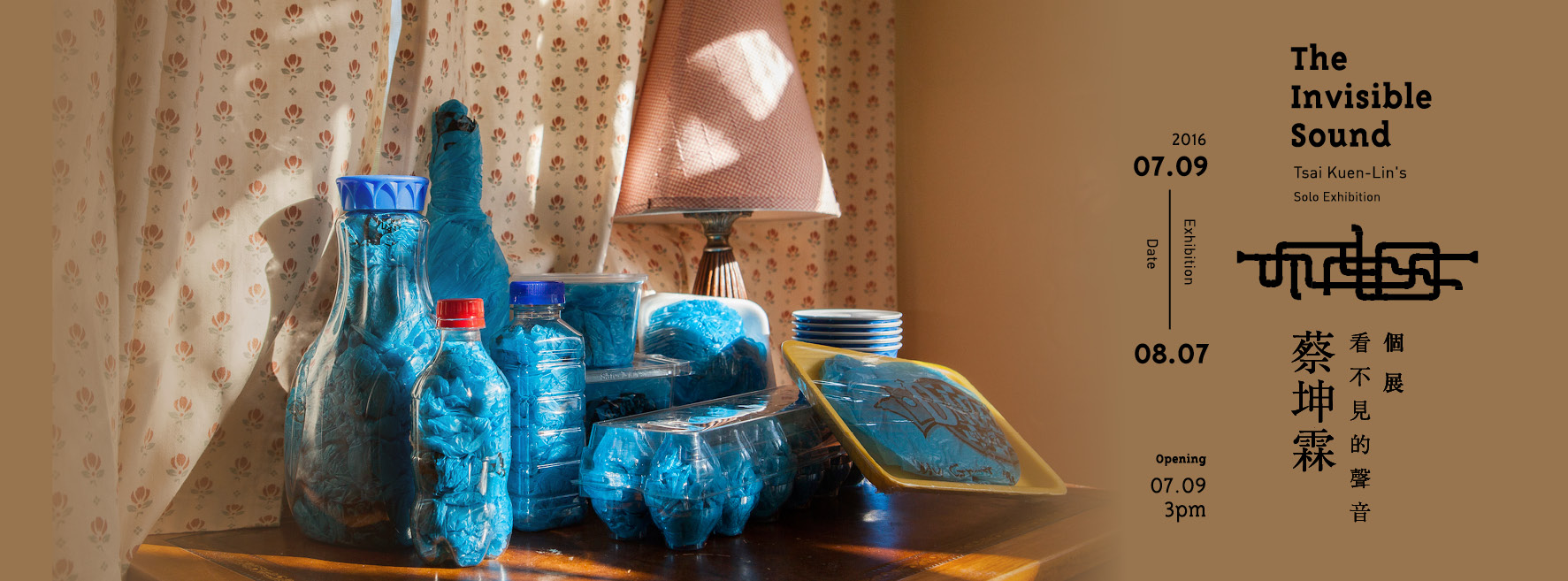
The Invisible Sound|看不見的聲音
- Kuenlin
- 16 7 月, 2016
- 在〈The Invisible Sound|看不見的聲音〉中留言功能已關閉
「聲音,可以被看見嗎?」– 蔡坤霖
For English Version, please scroll down.
開幕茶會於7月9日(六)下午三點舉行。
本次展覽,將多方面的呈現蔡坤霖近年來的系列創作,展出複媒雕塑、錄像裝置、鑲嵌畫、版畫、攝影複媒等,橫跨多種媒材。
蔡坤霖希望跳脫以往只處理「聽覺介面」,進而跨展至「環境」,這個藝術家長久關心的議題,並嘗試將「聲音」定義,延伸到視覺領域。藝術家相信,不斷修正且開放的感知,才能理解事物的全貌。
本展即試圖呈現那些「看不見的聲音」,讓裏世界與表世界合在一起做為一種陳述、一種現象的表現,就彷彿是真實世界的處境的投射,透過藝術的形式將那些日常的經驗與不易被感知到的經驗黏合在一起,成為一個「未曾被看見,卻可被經驗的聲音」。
展覽的核心作品即是延續此概念,一個可拆解、視場域而定的大型裝置〈表與裏〉,製造出都市中的情境。裝置分為上下兩部分,下半部以藝術家熟悉的塑膠管為材料,並在裡頭放置各式各樣的模型,搭配聲音;200公分高的平台上半部觀眾則是邀請踏上架高的平台,平台上的風景 – 藝術家透過電子屏幕播放動物或是風景圖、搭配標本。營造出平台下的景觀呈現的是真實片段的生活,而平台上是刻意安排的風景,來製造反差,讓聽眾可以用一種開放的態度,來突破約定成俗的城市想像。
豐富的國際駐村經驗,是蔡坤霖創作靈感的來源。此次展覽將展出2013、15年在美國聖塔莫尼卡、克里夫蘭基金會(Cleveland Foundation)發展的靜物系列攝影作品,呈現美國日常生活中消費主義和現象。〈無機靜物〉則是一組攝影加上燈箱的作品,燈箱上頭「fake food」其實是在反諷有機食物的昂貴,是一般民眾無法享受的,而一般超市消費難道就是無機嗎?〈採買靜物〉採用古典繪畫中靜物畫的手法,透過擺拍、三角構圖等,來拍攝原來在台灣鼓勵回收使用的塑膠袋,在美國卻是鼓勵使用的現象。
〈秋吉舞台〉,則是以短焦投影技術,呈現在日本山口縣秋吉台國際藝術村生活場域中的一片落地窗,搭配解構後的能樂,展現不同時間不同光線,同一個地方的風景。
蔡坤霖將不同的展品集合展出,用一種小說的角度來呈現。大型裝置〈表與裏〉作為展覽的序曲,而作品〈無極〉則是這次展覽中的結論,透過因過重而下陷的壓在鏡面不鏽鋼為材料製作的棋盤的灰色棋子,表達出他對於世界不應該只是簡單的二分法,並不是非黑即白,如真實中的圍棋一樣,棋盤即是宇宙,乘載著混沌的環境,有著多種面向,複雜的情境。
關於藝術家
蔡坤霖,1979年出生於台南,台北藝術大學科技研究所媒體藝術組碩士,前後畢業於復興商工美工科繪畫組,和國立台灣藝術大學美術學系複媒組。
目前工作於台北,近年來以收集而來的聲音和塑膠管作為創作的基本元素的裝置讓人印象深刻,試圖以聽覺影響人們對於空間場所的慣性思考,藉由聽覺上的錯位來重新發現空間,但實際上媒材只是作為藝術家溝通材料,對於不同媒材熟稔和組合是其特色。
歷年個展包含美國克里夫蘭Waterloo Arts「Treesure House」(2015)、台北台新銀行文化藝術基金會「當我們這樣聽/說」(2015)、桃園789養雞場「經驗轉向」(2013)、台北關渡美術館「音鄉」(2011)等。
也曾參與過索卡好樣、粉樂町、非常廟藝文空間、國立台灣美術館、中國美術館等聯合展出。
重要典藏:
作品榮獲澳洲白兔美術館(White Rabbit Gallery)、台北捷運、新竹榮嘉文化藝術基金會、新光三越等,海內外公立和私人收藏。
歷年美日駐村:
2016日本山口縣秋吉台國際藝術村(AIAV)駐村藝術家。
2015美國克里夫蘭基金會(Cleveland Foundation)駐村藝術家。
2012美國洛杉磯18街藝術中心(18th Street Arts Center)駐村藝術家。
2010日本橫濱黃金町管理中心駐地藝術家。
Tsai Kuen-Lin’s Solo Exhibition “The Invisible Sound”
Duration:2016.07.09. Sat. – 2016.08.07. Sun.
Opening:2016.07.09. Sat. 3pm
“Can sound be seen?” – Tsai Kuen-Lin
Liang Gallery is pleased to announce Tsai Kuen-Lin’s solo exhibition “The Invisible Sound.” The exhibition will run from 9th July to 7th August 2016.
For his first exhibition at Liang Gallery, Tsai Kuen-Lin presents a diversity of artworks created in recent years from mixed-media sculpture to video installation and from printmaking, to photography installation.
Tsai attemps to elaborate his practice from “auditory interface” to the whole “environment” that has developed in recent years. He is also trying to extend the definition of the “sound” into the area of visual arts. The artist believes that the only way to understand the whole picture of things is through constantly revised perception.
“Invisible sound” is the narrative and representation of the inside and outside of the world. It could serve as the projection of real world through the artistic practice combining the daily experiences with nearly neglected experiences. The core idea of the exhibition is to present the sound, “unseen, yet to be experienced.”
Having developed this idea, the centerpiece of the exhibition is an assembled installation of variable dimensions Outside Inside (2016) with a scenario of the urban city. There are two parts of the installation, the lower one is formed with the artist’s signature material pipeline, which contains various models and sound. The upper part is a 200 meters high platform where visitors are invited to step on to view the manmade landscape with models and digital images. This installation presents the contrast between fabricated and real world that help the audience to imagine the city they should have anticipated.
As an artist regularly enrolling into international residecy programs, Tsai often graspes the inspiration during his residencies. The new still-life photography series was developed during his residency at Cleveland Foundation in the USA showing consumerism in daily life. Still Life – Non-Organic (2013) is the photography installation with a light box with a text “fake food” on it. The artist uses this playful text and display to offer the irony of the relationship between food and affordability. Still Life – Consumed (2015) uses the technique of classical painting such as staging and triangle composition to show that re-using and recycling is not encouraged in the USA.
In Akiyoshi Stage (2016) the artist uses the short focus projector to stage his residency in Japan. French window serves as a screen to show the fragment of the scenery in Akiyoshidai during different seasons. The video is also accompanied with deconstructed Noh music.
Tsai borrows the idea of the fiction to present this exhibition. The large-scale installation Outside Inside (2016) is the prelude, and the work Wuji (2016) serves as a closing part. Wuji is a sculpture inspired by the Chinese philosophy Taoism – the mirrored-polished chessboard with the sunk stone-made grey chess. The artist aims to show that the dichotomy of universe is not as simple as it might look – it is not only black and white.
About the Artist
Born in Tainan in 1979, Tsai Kuen-Lin graduated from the MFA Program in New Media Art at the Department of New Media Art of the Taipei National University of the Arts, BFA Program at the Department of Fine Arts of the National Taiwan University of the Arts, and Fu-Hsin Trade and Arts School respectively.
Currently, the artist works in Taipei. In recent years, he has been using sound and plastic pipes as the basic elements for his creative expression. He aims to use hearing in order to affect the inertial thoughts people usually have towards space and place. By means of dislocation the audience is allowed to rediscover the space, while the medium itself is the communication material of the artist.
Solo exhibitions include: “Treesure House” at Waterloo Arts in Cleveland in 2015, “As We Hear/Say” organized by the Taishin Bank Foundation for Arts and Culture in 2015, “Transformation of Experience” at 789 Chicken Farm in Taoyuan in 2013, and “Sound Home” at Kuandu Museum of Fine Arts in 2011.
The artist has also participated in various group shows at Soka Art Center, Very Fun Park, VT Artsalon, National Taiwan Museum of Fine Arts, and National Art Museum of China.
Important Colections:
Artworks have been collected by White Rabbit Gallery in Australia, Taipei Metro, Yeh Rong Jai Culture and Art Foundation in Hsinchu, and Shin Kong Mitsukoshi Department Store. His works have also been included in other public and private collections domestically and abroad.
Residency Experience:
2016 Akiyoshidai International Artist Village, Mine, Japan
2015 Cleveland Foundation, Cleveland, OH, USA
2012 18th Street Arts Center, Santa Monica, CA, USA
2010 Koganecho Area Management Center, Yokohama, Japan


