

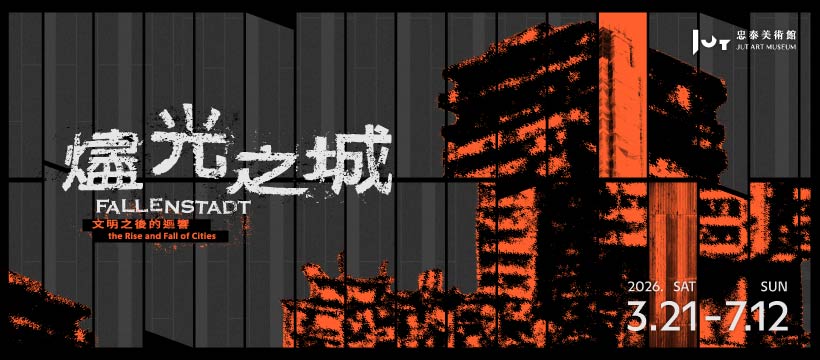
Fallenstadt: the Rise and Fall of Cities|燼光之城:文明之後的迴響
- Kuenlin
- 31 3 月, 2026
- 在〈Fallenstadt: the Rise and Fall of Cities|燼光之城:文明之後的迴響〉中留言功能已關閉
時間|Time:2026/03/21(六)- 2026/07/12(日)
開幕|Opening:2026/03/19(四)18:00
開幕論壇|Opening Panel Discussion:2026/03/21(六)14:00~17:00
地點|Venue:忠泰美術館/ JUT Art Museum
藝術家|Artist:Elom 20ce (Togo)、艾哈姆.賈布爾/ Ayham Jabr (Syria)、伊莎貝爾&艾佛雷多.阿奎禮贊/ Isabel and Alfredo Aquilizan, The Fruitjuice Factori Studio Collective (Philippines/ Australia)、阿布都.哈里克.阿濟茲/ Abdul Halik Azeez (Sri Lanka)、林書楷/ Shu-Kai Lin (Taiwan)、金雅瑛/ Ayoung Kim (South Korea)、韋恩.艾希莉/ Wayne Ashley (FuturePerfect Studio) (U.S.A)、馬克.薩瓦圖斯/ Mark Salvatus (Philippines)、格雷戈爾.卡斯帕/ Gregor Kasper (Germany)、致穎/ Musquiqui Chihying (Taiwan)、梅丁衍/ Dean-E Mei (Taiwan)、黃海欣/ Hai-Hsin Huang (Taiwan)、塞巴斯蒂安.摩爾多萬/ Sebastian Moldovan (Romania)、蔡坤霖/ Kuen-Lin Tsai (Taiwan)


Preface
Text / Jut Art Museum
“The question of what kind of city we want cannot be divorced from the question of what kind of people we want to be.”——David Harvey, Rebel Cities: From the Right to the City to the Urban Revolution, 2012
Cities are ever-evolving organisms, defined by constant growth, construction, and expansion. Like beacons in the darkness, they attract humans to gather, interact, and survive, becoming the vessels of culture and civilization. However, the evolution of a city is not a linear progression but a cycle of rise and fall or restoration and rupture amidst mounting tensions and changes. These urban conditions and life experiences forced into view by radical upheavals are exactly what this exhibition seeks to explore.
As a rich tapestry of history, culture, and future visions, the exhibition Fallenstadt: the Rise and Fall of Cities observes and reflects on the cyclical nature of human civilization. Structural cataclysms such as wars, climate catastrophes, industrial transformations, and the imbalance of power have left many cities in a state of precarity. These cities undergo repeated cycles of collapse, mending, and rebirth, manifesting their inherent fragility and resilience. The metamorphosis of a city is tantamount to blazing flames. While the flames may go out, the embers never die, perpetuating the cycle of prosperity and decline. Co-curated by Nobuo Takamori and the Jut Art Museum team, this exhibition focuses on non-occidental urban experiences that are less covered by mainstream narratives and have relatively limited discursive power. Through the works of 11 artists and collectives from the Philippines, Sri Lanka, Syria, Romania, South Korea, and Taiwan, this exhibition rethinks what a “city” truly looks like under varying historical, political, and economic conditions. From the demolition of historic buildings in Bucharest, the dystopian urban visions of Damascus, and the e-waste settlements of Agbogbloshie in Ghana, to the Umbrella Movement in Hong Kong and the relocation caused by industrial transformation in Tainan, Taiwan, these seemingly distant urban stories mirror the very rupture, reorganization, and remaking that our own modern cities are experiencing.
Since its inception in 2016, the Jut Art Museum has consistently addressed issues concerning the “city” and the “future” through a succession of contemporary art exhibitions, such as A Non-Existent Place, The Flying Land, Paradise Lost, and Broken Landscapes. The current exhibition, Fallenstadt, not only responds to the museum’s decade-long dedication to urban issues, but also stands at this critical juncture in history to raise essential questions about urban civilization, future lifestyles, and our collective imagination, thereby opening up a new space for further dialectical inquiry, dialogue, and contemplation.
Curator Statement
Fallenstadt: the Rise and Fall of Cities
Text / Nobuo Takamori
Since the first cities rose from the earth millennia ago, they have stood as a defining hallmark of human civilization. Agglomerating considerable populations and wealth, cities have fostered the development of cultural assets and innovative technologies throughout history. Statistically speaking, however, urban civilization does not necessarily equate to the concept of a comfortable existence. More than 50% of the world’s total population resides in cities today. However, not every city that accommodates this massive influx of people aligns with our idealized vision of urban life. Currently, there are over 80 cities worldwide with populations exceeding 5 million, a scale comparable to that of the Greater Taipei Area. Yet, among these megacities scattered across the globe, nearly half fail to provide the majority of their inhabitants with basic public services.
While cities across the developing world appear fraught with existential crises, their integration into the globalized trade system places them in a paradoxical position. They serve as hubs for trading and processing the detritus of global overproduction at the price of bearing greater environmental risks. In this sense, as humanity is ushered into an era characterized by increasingly severe living conditions and geopolitical complexities, it remains debatable whether the idealized cities of developed countries are better equipped to withstand extreme circumstances, or if the emerging cities of the developing world will prove to be the “hidden champions” in the race for survival. Our experience of the COVID-19 pandemic showed that even affluent, idealized cities may expose their potential vulnerabilities if they lack the requisite resilience and flexibility to address unforeseen, large-scale catastrophes.
Featuring artists from Taiwan, South Korea, the Philippines, Sri Lanka, Syria, Romania, and Germany, this exhibition presents scenes that resonate with Italo Calvino’s depictions in Invisible Cities. The grandeur and decadence, the courage and absurdity, as well as the wisdom and annihilation of human civilization find expression in the cities beleaguered by flooding, self-abasement, crises, global detritus, and encroaching warfare. Cities serve as a portrayal of humanity per se. Their multifaceted façades and complexities are projections of human consciousness. Acting as a mirror, cities reflect our pride, aspirations, morality, dread, desires, and depravity. Welcome to Fallenstadt, a place where reverberations linger just before the torch of civilization is extinguished.
圖片來源 ©忠泰美術館
文/忠泰美術館
「我們希望擁有怎樣的城市,與我們想要成為什麼樣的人,兩者是不可分離的。」——大衛.哈維(David Harvey)《叛逆的城市:從擁有城市權利到城市革命》,2012 *
城市是不停發展、建造與擴張的有機體,如黑暗中的火光,吸引人類在此群聚、活動與生存,並成為文化與文明的載體。然而,城市的生成並非線性前進,而是在不斷累積的壓力與變動中,反覆經歷興起與衰敗、修復與斷裂。本展所關注的,正是那些在劇烈變動下被迫顯影的城市狀態與生活經驗。
本展《燼光之城──文明之後的迴響》結合歷史、文化與未來想像,觀察並反思人類文明發展週期的循環。戰爭、氣候災難、產業轉型與權力結構失衡等結構性變動,使許多城市長期處於臨界狀態,反覆經歷崩解、修補與再生的過程,彰顯出不同城市所承載的脆弱性與韌性。城市蛻變如烈焰燃燒,餘燼卻始終頑強地生生不息,從未結束興衰之循環。本展邀請策展人高森信男與美術館團隊共同策劃,聚焦於較少被主流敘事所涵蓋、話語權相對有限的非歐美城市經驗,並透過菲律賓、斯里蘭卡、敘利亞、羅馬尼亞、韓國及臺灣等11組藝術家的創作,重新思考「城市」在不同歷史、政治與經濟條件下的現實樣貌。從羅馬尼亞首都布加勒斯特的歷史建物拆除、敘利亞首都大馬士革的反烏托邦城市想像、加納首都郊區阿格博格布洛謝的電子廢棄物聚落、香港雨傘運動,到臺灣臺南的產業轉型與家園拆遷,這些看似遙遠的城市故事,映照出我們所身處的現代城市正在歷經的斷裂、重組與再造。
自2016年忠泰美術館開館以來,陸續推出《不存在的地方》、《逆旅之域》、《失樂園──當代城市文明的凝視與寓意》及《殘山剩水──我們的城市失敗了嗎?》等展覽,透過當代藝術呈現美術館長期探討的「城市」與「未來」議題。本展不僅回應忠泰美術館近十年對城市議題的積累,也在當下的時代節點中,提出關於城市文明、未來生活與集體想像的關鍵提問,開啟進一步辯證、對話與思考的空間。
策展論述
燼光之城──文明之後的迴響
策展人:高森信男
當第一座城市自數千年前佇立於地表以來,城市便成為人類文明的重要象徵。城市聚集了大量的人口及財富,亦催生了歷朝歷代的文化資產和創新科技。從統計的角度來觀察,城市文明其實無法與舒適的生活想像劃上等號。截至今日,全球已有超過半數的人口居住於城市中,然而這些聚集全球大量人口的城市,並非每座都符合我們對美好城市的想像圖景。目前全球約有80多座城市,其人口接近雙北都會圈的人口量級,居民總數超過500萬人。然而散佈在全球的這些巨型城市,至少有近半數的城市無法提供多數居民基本的公共服務設施。
大量開發中國家的城市看似充滿了生存上的危機,但在全球化的貿易體系下他們一方面承受著較高的環境變異風險,另一方面甚至協助交易及處理來自全球生產過剩的產品及廢棄物。然而在未來人類生存環境及地緣政治越發困難的時代,究竟是理想的已開發國家城市較能對抗極端情境,還是開發中國家的新興城市才是生存賽中的隱形冠軍,尚無定論。Covid-19疫情的經驗便讓我們看到即便是理想中的富裕城市,若在面對超乎預期的大型災變時沒有相對應的韌性及彈性,則依舊可能展現出其脆弱不堪的一面。
本展邀請來自臺灣、韓國、菲律賓、斯里蘭卡、敘利亞、羅馬尼亞及德國等地的藝術家,將如同卡爾維諾(Italo Calvino)《看不見的城市》一般的場景呈現於觀眾面前:在淹水的城市、自卑的城市、危機之中的城市、被全球廢物堆滿的城市以及戰火蔓延的城市之中,我們可以看到人類文明的偉大及墮落、勇氣及荒謬、智慧與毀滅。城市就是人類自身的寫照,她們的多樣面貌及複雜性便是人類自身意識的延伸。城市其實如同一面鏡子,映射出我們的自尊、夢想、道德、恐懼、慾望及墮落。歡迎來到燼光之城:在文明的火焰被捻熄前夕的迴響之處。